
Champion of the World (Part 1)
His Life for Your Life, and Your Life for His
“Send your man out!”
“Send him out—if you have one!”
The challenge was for a winner-take-all combat. A guaranteed sold-out prize fight with a massive payday. Two champions going mano-a-mano, with each representing an opposing side.
Except no one would accept the challenge. Day after day, the champion would harass, harangue, and mock that there was no opponent from the other side. Was there no strong man against which he could measure himself? No challenger to slake the giant’s boredom? If nothing else, send out a dog to kick around just for the sport of it. Why no takers?
When one finally stepped forward, the champion could hardly believe his eyes. Goliath began mocking the mockery, scorning the child’s play. His question, “Am I a dog, that you come to me with sticks?” is most likely a dig at David’s legs compared to those of the giant’s. But with those two sticks David would run—not away—but right into the battle, his face set like flint, knowing he would not be ashamed (Isaiah 50:7).
As for the giant, the Scripture is clear to say that his armor was a “coat of mail” (1 Samuel 17:5, NKJV). Follow the details—they are there for a reason. Christian Scripture uses images, symbols, types, and patterns to convey messages. When we read, “coat of mail,” we should imagine armor that is layered, resembling snakeskin. And when you think of a snake in the Bible, where else do you see that image?
Very purposely, Goliath is presented to us as a giant snake. Israel had its own giant in the form of Saul, who stood head and shoulders above his fellow countrymen. But Saul was not the man for this enemy. Nor was Saul’s armor, the best technology his country had to offer for self-defense, going to work. That would have been nothing more than human self-sufficiency, which is why it didn’t fit David. No, this was to be a spiritual battle on a cosmic scale waged in material form.
The ancient prophesy from God to the serpent that a human offspring, “will crush your head, and you will strike his heel” was about to take another step toward fulfillment (Genesis 3:15, NIV). Assuming you know how David defeats Goliath, watch now what happens to Goliath’s head. Again, the details matter.
“Then David ran and stood over the Philistine, and took [Goliath’s] sword and drew it out of its sheath and finished him, and cut off his head with it. And David took the Philistine’s head and brought it to Jerusalem. So when David returned from killing the Philistine, Abner took him and brought him before Saul with the Philistine’s head in his hand” (1 Samuel 17:51, 54, 57, NASB).
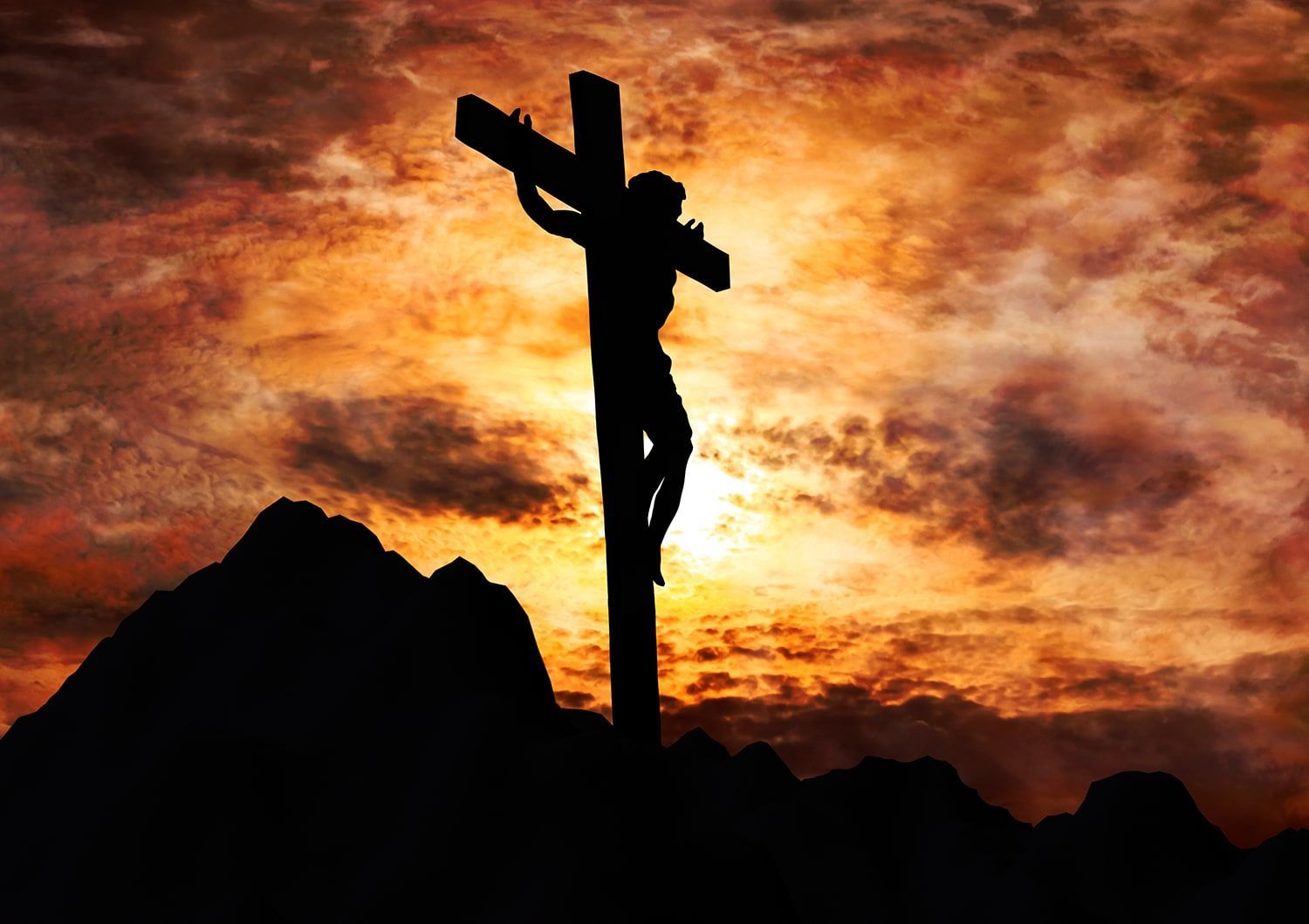
The writer of 1 Samuel never tells us what David, Abner, or Saul did with Goliath’s head. Likely in disgust someone dug a hole and buried it outside the city. It would take another thousand years (according to Matthew’s Gospel, 3 sets of 14 generations) before we find Goliath’s head surfacing. Just that over those thousand years Goliath’s head became a placename for where his head was buried. “And they brought Jesus to a place called Golgotha (which means ‘Place of the Skull’)” (Mark 15:22, NLT).
Jesus being crucified atop Goliath’s head is no coincidence. In retrospect, we know this was the plan all along. The serpent would indeed strike at the heel of the Son of man. And Jesus would in fact suffer, bleed, and die. But the effect of the serpent’s strike was temporary. Jesus’ vindication came three days later with his resurrection from the dead, thereby breaking the power of Satan and restoring God’s authority over his creation. Jesus’ battle cry, “It is finished,” is the champion’s shout of victory!
There’s more.
Recall that when Goliath and David went to fight each other, they did so as representatives of their two sides. David “fought as a champion on behalf of [Israel]. He was their representative. And David’s victory was credited—it was imputed—to those he represented. All of Israel, we could say, was ‘in David,’ even though they themselves were not active participants in the battle” (Rankin Wilbourne, Union with Christ: The Way to Know and Enjoy God, p. 44).
To take a word from C. S. Lewis, there is a deeper “magic,” as it were, going on here. As the Israelites were “in David” when David defeated Goliath, so Christians are now “in Christ” when Jesus defeats Satan, sin, and death. “Therefore, if anyone is in Christ, he is a new creation. The old [life in sin] has passed away; behold, the new [life in Christ] has come” (2 Corinthians 5:17, ESV). Theologians refer to this “in Christ-ness” as union with Christ. And the implications of this union of God and humankind are truly staggering.
Consider, “But by [God’s] doing you are in Christ Jesus, who became to us wisdom from God, and righteousness and sanctification and redemption” (1 Corinthians 1:30, NASB). What we could not do through good works and law keeping, God did for us in Christ. Therefore, “as it is written, ‘Let him who boasts, boast in the Lord’” (1:31). At one level, with Christ as our righteousness, he stands in God’s court as both our attorney and substitute. He pleads our innocence through our union with him, and the verdict comes back, “Justified!” That is a legal declaration, and the rendering happens outside us.
At another level, there is a relational intimacy in one’s union with Christ that is profoundly beautiful, powerful, and mysterious. Paul tries to capture the intimacy when he writes, “I have been crucified with Christ. It is no longer I who live, but Christ lives in me. And the life I now live in the flesh I live by faith in the Son of God, who loved me and gave himself for me (Galatians 2:20, ESV).
I will continue to give this statement further thought, but I’m inclined to say that the phrase, “who loved me and gave himself for me” is the foundational truth of all the counseling I give in a typical week. If we would sit with and increasingly internalize the reality of God’s love for us in Christ and our union with him, then healing, security, humility, and freedom would follow. There would be grace upon grace, both given and received. And then like Jesus has done for us, we could give ourselves away to others for their sake rather than our own.
With this little hook: one cannot live in this world as Jesus did and not suffer. We are “fellow heirs with Christ, provided we suffer with him in order that we may also be glorified with him” (Romans 8:17, ESV).
I hope to expand on this in my next post.
Be assured, fellow Christian, that the good work Christ has begun in you he will surely finish.
“We do this by keeping our eyes on Jesus, the champion who initiates and perfects our faith” (Hebrews 12:2, NLT). Happy Easter, everyone!